

Process Monitoring Technologies for Laser Welding
Locating the seam, monitoring the process, ensuring quality
In laser welding, process stability determines component quality, scrap rates, and cost-effectiveness. In automated production lines, there is often little room for error: high production volumes, short cycle times, challenging materials, and strict quality specifications must be balanced against real-world component tolerances.
Even small deviations in focus position, seam position, gap, weld geometry, or penetration depth can affect the quality of the joint. Process monitoring detects such deviations early—during welding, immediately afterward, or even before the actual process begins.
This creates transparency right where quality is produced: in the ongoing manufacturing process. Applications can run welding processes more consistently, detect errors faster, document quality, and reduce rework or scrap.
Why is process monitoring crucial in laser welding?
In mass production, it is not enough to inspect welds only after the component is finished. If defects are detected too late, scrap, rework, or unplanned process interruptions have often already occurred.
Process monitoring brings quality assessment closer to the production process. Relevant signals are captured inline, weld positions are detected, penetration depths are measured, and welds are optically inspected downstream. This allows deviations to be evaluated more quickly and production processes to be optimized more effectively.
This transparency becomes a decisive advantage, particularly in safety-critical applications such as e-mobility, automotive body construction, lightweight construction, electronics, or medical technology.
Process monitoring before, during, and after welding
Depending on the application, quality assurance does not begin only with the finished weld. The key is to identify relevant deviations at the right stage in the process—before, during, or after laser welding.
Pre-Process: Seam Guidance
Before welding, it must be clear where the actual joint location is. Optical seam guidance detects the actual seam position and supports the precise guidance of the laser along the joint. This allows for better control of component tolerances, clamping deviations, and varying seam geometries.
In-Process: Online Quality Monitoring
During laser welding, process signals provide important information on stability and quality. Online quality monitoring highlights deviations in real time and enables rapid assessment of critical changes.
In-Process: Penetration Depth Measurement
Weld penetration depth is a key quality factor for many laser welded joints. When measured directly during the process, deviations can be detected early, and safety-critical joints can be better evaluated.
In-Process: Gap Filling and Adaptive Process Control
Real components come with tolerances. Gaps, varying joint configurations, or positional deviations can influence the welding process. Adaptive process control helps adjust the process to these conditions—with or without filler wire, depending on the application.
Post-Process: Optical Weld Inspection
After welding, the weld is visually inspected. This allows visible, geometric, or near-surface defects to be detected and documented. In this way, weld quality is automatically evaluated and made traceable for quality assurance purposes.
How does process data translate into consistent weld quality?
Process monitoring is more than just an additional check. It provides the data foundation needed to better understand laser welding processes, control them more consistently, and optimize them over the long term.
The sooner deviations become apparent, the faster applications can respond. This reduces scrap, minimizes rework, and supports consistent quality—especially for complex components, high-volume production, and automated production lines.
Additional Information
Depending on the welding task, various Precitec solutions are used—ranging from inline monitoring and penetration depth measurement to seam guidance and scanner-based laser welding, all the way to optical seam inspection.
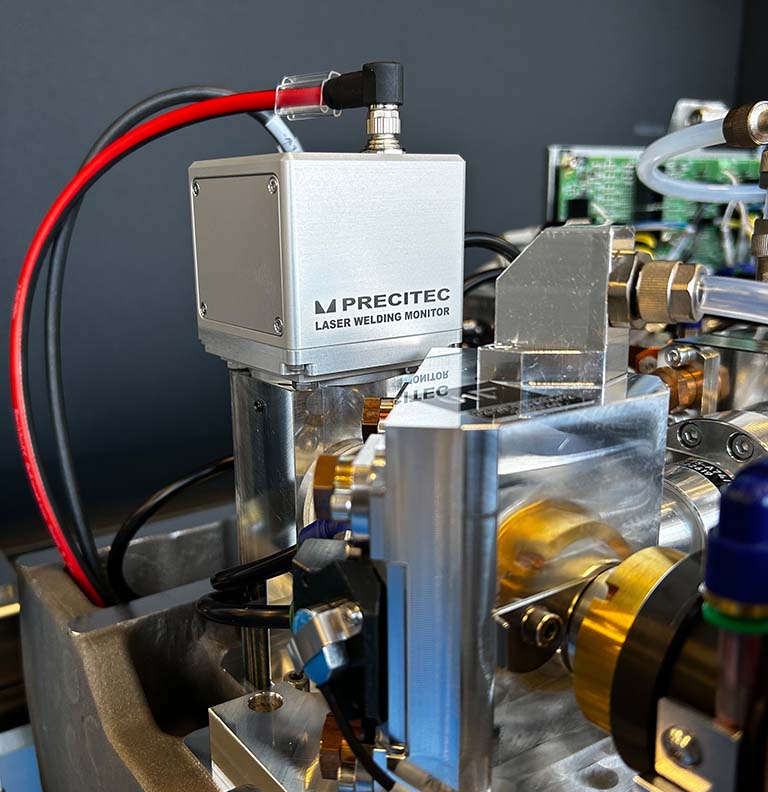
Laser Welding Monitor LWM – erkennt Prozessabweichungen beim Laserschweißen in Echtzeit und dokumentiert die Qualität jeder Schweißung.
Laser Welding Monitor LWM AI – Inline process monitoring with AI-supported defect classification, quality prediction, and traceability.
Precitec IDM – measures penetration depth directly during the process.
WeldMaster Systems – support seam guidance, process control, and automated laser welding.
ScanWelder – Enables fast, flexible remote laser welding.
ScanMaster Plus – combines scanner processing with precise beam guidance and AI-based evaluation.
SeamControl – visually inspects weld seams and evaluates seam quality using AI.
Would you like to reliably monitor your laser welding process?
Then please feel free to contact us. We’ll advise you on suitable solutions for process monitoring, seam guidance, penetration depth measurement, and seam inspection in laser welding.