
Seam detection and seam tracking in laser welding
Guide the laser where the joint actually is
In automated laser welding, a programmed path alone is not enough. What matters is the actual position of the joint on the real component. Even in highly controlled series production, parts vary because of manufacturing, clamping and assembly tolerances.
Forming operations, changing joint geometries and positional deviations can shift the seam away from its nominal contour. If this offset is not corrected, the result may be seam misalignment, unstable processes, rework, scrap or inconsistent weld quality.
Optical seam finding and seam tracking identify the real joint, follow its position and provide correction data for the laser beam, processing head, robot or scanner. Energy is applied exactly where it is needed—even at high process speeds, on complex parts and under changing production conditions.
Camera-Based 2D and 3D Detection
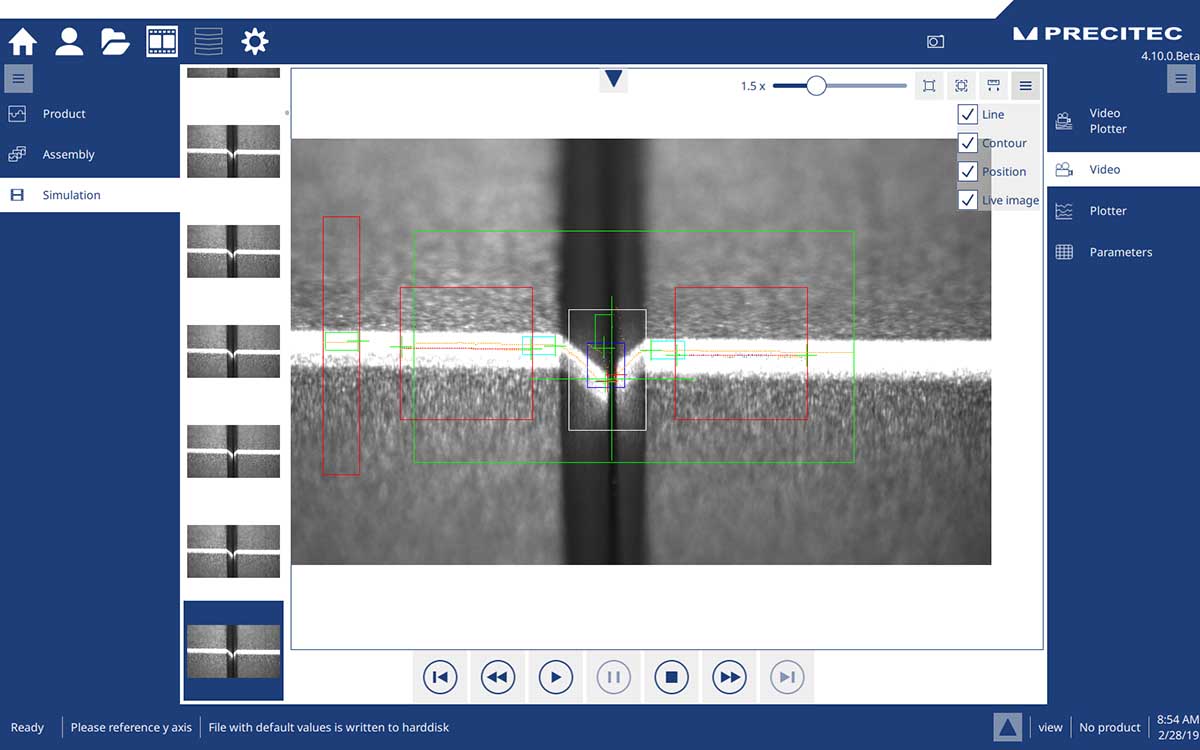
Two complementary methods are widely used to detect a joint optically: high-resolution 2D grayscale imaging and 3D measurement with a projected laser line, which reveals the geometric features of the joint.
Precitec combines both approaches in one sensor system. Accurate 3D profiles of the seam geometry and detailed 2D surface information are captured at the same time. This allows joint position, geometry and visible features to be evaluated together—even on challenging surfaces or in demanding industrial environments.
The combined data provides a flexible foundation for handling different joint types, component tolerances and joining conditions while guiding the laser reliably along the actual seam.
How seam detection and tracking stabilize the process
Before or during welding, the system determines the actual position of the joint. These coordinates are used to align the laser beam, processing head, robot path or scanner trajectory with high precision.
During the process, the detected seam can be tracked continuously. The beam therefore remains centered on the joint despite changing geometries, dynamic motion or component variation.
The result is repeatable weld quality, less rework and scrap, and greater process reliability—especially in fast, high-mix series production.
Benefits of seam detection and seam tracking
- Alignment to the actual joint instead of relying only on the nominal programmed path
- Accurate laser guidance despite component, clamping and assembly tolerances
- Less seam offset, rework and scrap
- More stable weld quality in automated production
- A reliable data basis for adaptive control and quality assurance
Seam tracking for different laser welding processes
Depending on the application, seam tracking can be integrated into robot-based welding cells, scanner-based remote welding processes or adaptive welding systems. The key is to detect the real joint reliably and adapt the process to its position.
Remote laser welding requires highly dynamic and accurate beam positioning. For complex parts or changing joining conditions, seam tracking can be combined with process monitoring, quality evaluation or adaptive control. In wire-fed applications, seam and gap data can also be used to adapt wire delivery to the actual joint condition.
Related Solutions
Precitec offers solutions for a wide range of welding tasks—from optical seam finding and tracking to scanner-based laser welding and adaptive process control.
WeldMaster systems —seam detection, seam tracking and process control for automated laser welding.
ScanWelder —fast, flexible remote laser welding with precise beam guidance.
ScanMaster Plus – scanner processing with precise beam control and AI-supported evaluation.
WeldMaster Wire Select – optical seam tracking and adaptive wire feeding for filler-wire applications.