
Laser processes for battery components: Precise and stable connections for e-mobility
Efficient laser welding processes for copper and aluminum connections in battery production
Laser processes play a central role in the production of modern battery components. Particularly when joining copper and aluminum, the highest standards of precision, process stability and reproducibility must be met. By using modern laser welding processes, even challenging material combinations can be processed reliably and economically in series production.
Dynamic beam guidance, intelligent process monitoring and innovative gap bridging methods enable stable processes even with high cycle times and complex geometries. This makes laser processes a key component for the efficient production of battery systems in electromobility.
What are the challenges of laser processes for battery components?
Different material properties of copper and aluminum
Due to their physical properties, copper and aluminum place special demands on the welding process. High reflection, different melting points and thermal conductivities influence the energy input and require precise and stable process control.
High demands on process stability and quality
Battery components are safety-critical and must guarantee permanently reliable electrical connections. Even minor process deviations can lead to increased resistance, quality losses or component failures.
Production under high cycle times and series conditions
Short cycle times and reproducible processes are crucial in industrial series production. Laser processes must therefore be highly dynamic as well as stable and flexible.
Laser welding of cylindrical battery cells
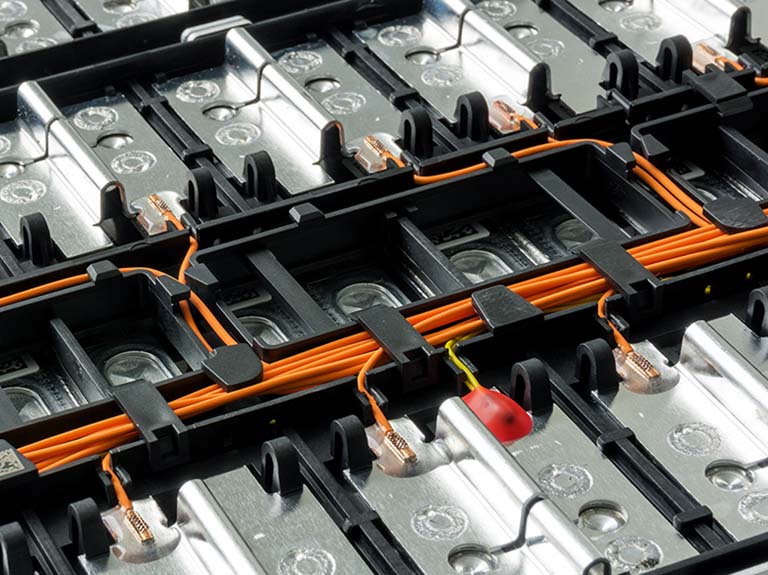
Cylindrical battery cells place high demands on electrical contacting. When laser welding cell connectors, busbars and contact surfaces, precise, reproducible connections with low heat input must be created in order to protect the cells thermally and ensure permanently low contact resistances.
The video shows an example of how laser processes can be implemented for cylindrical battery cells. Precitec technologies support such applications with dynamic beam guidance, precise focusing and integrable process monitoring. As a result, stable welding processes can be realized even with short cycle times and high requirements in series production.
Technologies for stable and efficient laser processes
Scanner welding and remote laser welding
By using scanner optics, the laser beam can be guided over the component in a highly dynamic manner. Remote laser welding enables processing without mechanical movement and significantly reduces non-productive times. As a result, high productivity and short cycle times can be achieved.
Gap bridging through wire feed
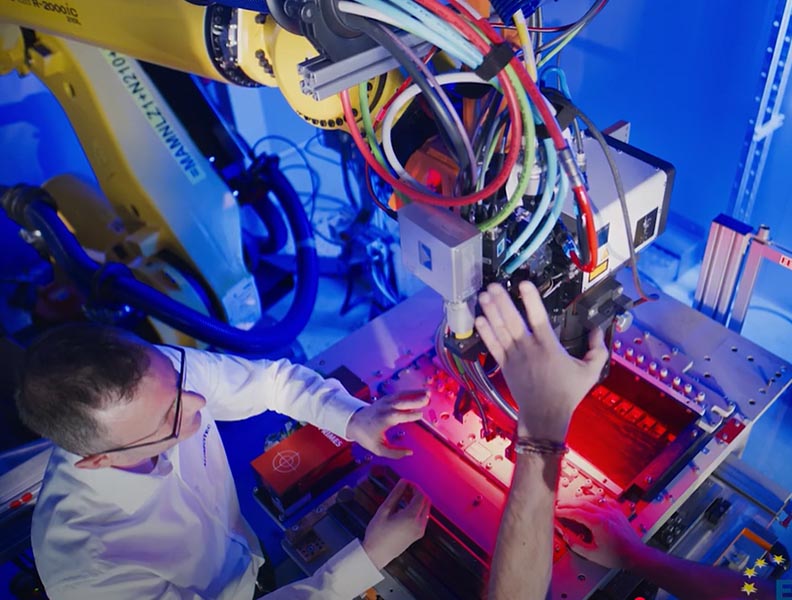
With varying component tolerances, stable gap bridging is crucial. Wire-based processes enable a reliable connection even with larger gaps and improve process reliability, especially when welding aluminum.
Inline process monitoring and quality control
Modern sensor systems record the welding process in real time and enable continuous monitoring. Process deviations can be detected at an early stage and the quality of the joints can be specifically assured.
Typical applications of laser processes in battery components
Busbar connections in battery modules
When welding busbars, high electrical conductivity and minimal contact resistance are crucial. Laser processes enable precise and reproducible connections of copper and aluminum conductors and thus contribute to the efficiency and performance of battery systems.
Cell connectors and contacts (cell-to-cell interconnects)
The connection of individual battery cells requires maximum precision and process stability. Laser welding processes enable reliable contacting with low heat input, which protects sensitive cell structures.
Battery housings and structural components
Aluminum housings and structural components must be joined in a leak-tight, stable and process-reliable manner. In laser welding of aluminum, controlled heat input and high weld seam quality are essential to ensure both mechanical stability and leak tightness.
Why are laser processes the ideal solution for battery components?
Laser processes enable the economical and high-quality production of battery components. They combine high process speed with stable quality and are therefore ideal for use in series production.
The main advantages at a glance:
- High precision and reproducible results
- Low heat-affected zone to protect sensitive components
- High process speed and productivity
- Flexible integration into automated production lines
Future-proof laser processes for battery production
The requirements for laser processes in e-mobility are constantly increasing. In the future, adaptive processes, data-based evaluation and intelligent control systems will continue to gain in importance. Modern laser technologies provide the basis for reliably meeting increasing quality requirements and production volumes.
You can find more information on applications in e-mobility on