
Gap Bridging in Laser Welding
Compensating for Component Tolerances and Stabilizing the Welding Process
In series production, laser welding processes must adapt to real-world joining conditions. Gaps between components, dimensional tolerances, positioning variations, clamping deviations, and changes in joint geometry can prevent parts from fitting together perfectly.
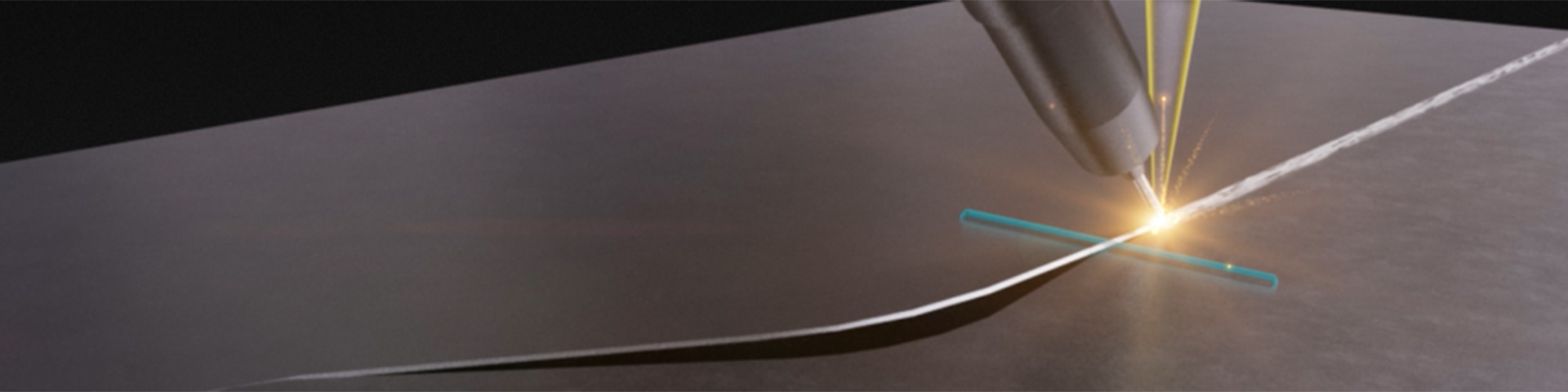
Gap bridging involves detecting and evaluating the actual joining conditions so that the welding process can be adjusted accordingly. Depending on the application, seam tracking, path correction, adaptive process parameters, beam oscillation, or filler wire can be used to compensate for variations in gap width.
This helps maintain consistent weld quality even when component tolerances vary or the parts are not positioned perfectly.
Why Is Gap Bridging Important in Laser Welding?
Laser welding offers high energy density, low heat input, narrow welds, and high processing speeds. However, the process can be sensitive to joint gaps, alignment errors, and variations in component positioning.
If the laser beam does not precisely follow the joint line or if the gap between the components is too large, weld quality can be affected. Possible consequences include lack of fusion, insufficient penetration, spatter, porosity, weld misalignment, and the need for rework.
Reliable gap bridging helps maintain consistent welding quality despite component tolerances and variations in the production process. It therefore contributes to reducing defects, scrap, and rework costs.
Detecting the Actual Joint Position
The programmed path provides only a reference. The actual position of the joint and the width of the gap must be detected directly on the component.
Seam detection and seam tracking systems record the actual geometry of the joint before or during welding. The measured data can then be used to precisely adjust the laser path, travel speed, focal position, laser power, or other process parameters.
This enables the welding process to react automatically to variations in component position and joint geometry.
Gap Bridging With or Without Filler Wire
Depending on the gap width and the requirements of the application, gap bridging can be performed with or without filler wire.
For smaller gaps, a controlled oscillating movement of the laser beam can distribute the energy across both edges of the joint. This beam oscillation enlarges the processing area and increases the process tolerance to positioning variations.
The beam movement and energy distribution can be adapted to the specific joining conditions. This helps stabilize the molten pool and improve weld quality.
For larger or varying joint gaps, filler wire may be required. The wire introduces additional material into the joint and makes it possible to fill the gap between the components.
The amount of filler wire can be adjusted according to the actual gap width. Wire feed rate, laser power, welding speed, and beam path are coordinated to produce a uniform weld and a reliable joint.
Applications of Gap Bridging in Laser Welding
Gap bridging is particularly important when high quality requirements must be combined with real-world component tolerances.
Typical applications include:
- welding automotive components;
- manufacturing body structures and lightweight assemblies;
- welding batteries and e-mobility components;
- joining aluminum components;
- welding sheet metal and profiles;
- processing components with varying tolerances;
- automated welding processes using filler wire.
By combining seam detection with adaptive process control, laser welding systems can reliably process components whose position or geometry varies.
Precitec Solutions for Gap Bridging
Precitec solutions combine seam detection, precise beam guidance, and adaptive welding process control.
WeldMaster Wire Select detects the joint position and gap width so that the beam path and filler wire feed can be adapted to the actual joining conditions. The amount of wire is therefore adjusted according to the measured gap.
WeldMaster Systems –make it possible to integrate seam detection, seam tracking, beam guidance, and process control functions into automated production lines.
ScanWelder enables fast and flexible remote laser welding with precise beam guidance. The laser path can be adjusted dynamically to compensate for variations in the joint position.
ScanMaster Plus combines scanner-based processing with precise beam guidance and AI-supported analysis. This combination helps detect joint characteristics, adapt the process, and improve welding stability in automated applications.