
Scanner welding: Highly dynamic remote laser welding for industry
What is scanner welding?
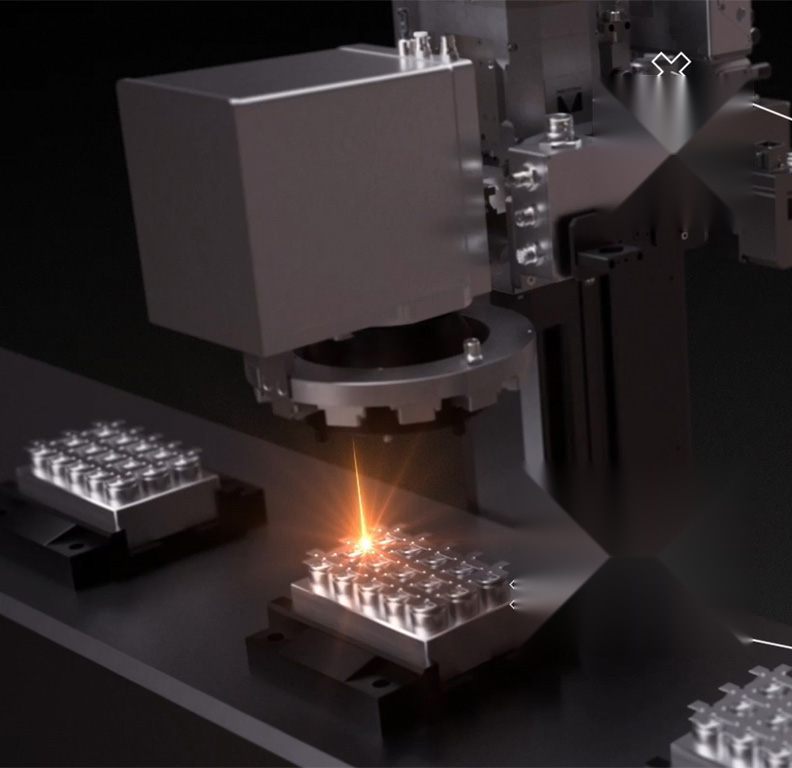
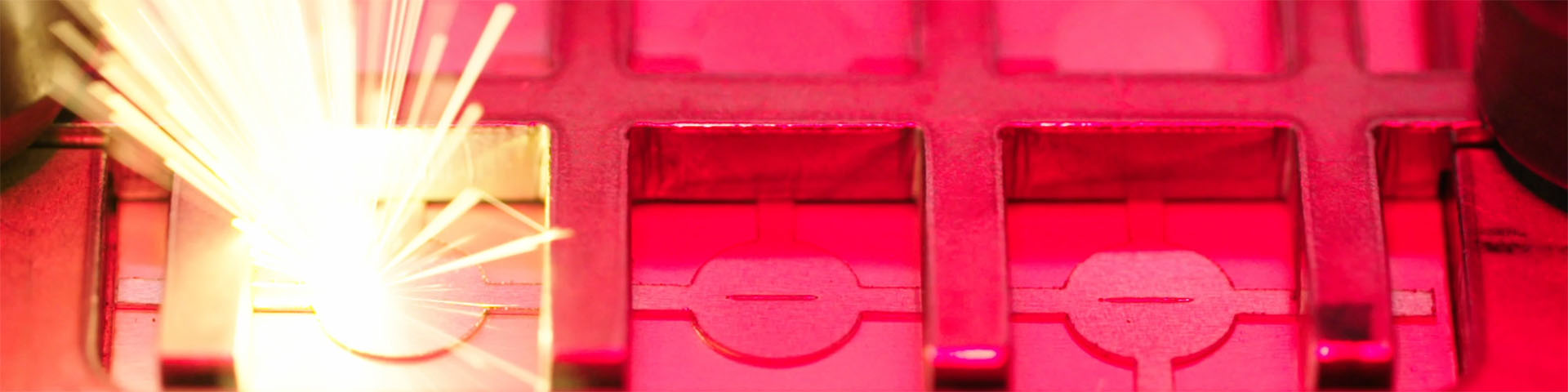
Scanner welding is a highly dynamic remote laser welding process in which the laser beam is guided precisely and almost instantaneously over the workpiece using scanner optics. As a result, the process enables extremely high welding speeds, flexible beam guidance and efficient processing without mechanical movement of the optics for beam guidance.
Scanner welding enables highly productive manufacturing without non-productive times. Thanks to the dynamic beam deflection, the laser beam is moved between different welding positions in fractions of a second - completely without mechanical axis movement to position the beam. This principle forms the basis for "welding on the fly" and makes it possible to process even complex geometries with maximum speed and precision.
The process is based on the optical deflection of the laser beam via highly dynamic mirrors in the scanner head. These position the beam exactly where the energy is needed - quickly, precisely and reproducibly.
Dynamic beam guidance instead of mechanical movement
The difference to conventional processes is fundamental:
While mechanical axes or robots move the processing head in classic laser welding, every movement in scanner welding takes place directly in the beam. Inside the scanner head, galvanometer mirrors direct the laser beam across the entire working field by means of extremely fine angle changes. Due to their low mass, these mirrors react extremely quickly - they accelerate and stop in the shortest possible time.
The laser follows this dynamic immediately: it jumps from point to point, without delay, without detours - and with a precision that is almost impossible to achieve mechanically.
"Welding on the fly" - welding without standing still
“Welding on the fly” describes a continuous process principle in which the movement of the robot or gantry is synchronized with the highly dynamic beam deflection of the scanner optics. While the motion system guides the processing head along the component, the galvo mirrors simultaneously position the laser beam precisely on the respective weld points. As a result, the laser no longer works step by step, but within a continuous process: weld points are addressed directly, without the system having to stop at each position or perform additional positioning movements.
This enables particularly efficient processing with high speed, flexible beam guidance and precisely controlled energy input. The laser energy is applied exactly where it is needed — quickly, reproducibly and without stopping. In this way, “welding on the fly” combines short cycle times with a high level of process control, making scanner welding particularly attractive for automated series production processes.
Precision and repeatability
The high speed of scanner welding requires equally precise control. The position of the laser beam is digitally controlled and can be reproduced with high repeat accuracy. This means that even complex geometries can be implemented precisely. The energy is applied in a targeted manner - controlled, reproducible and stable. The result is a process that is not only fast, but also reliable.
Intelligent process control and AI support
As dynamics increase, so do the requirements for process control. As the laser beam switches between positions in fractions of a second, all relevant parameters must be continuously monitored and precisely adjusted. Data-based and AI-supported methods make it possible to evaluate process signals in real time and detect deviations at an early stage. On this basis, the process control can be adjusted immediately - not just downstream, but directly during welding.
The result is a system that not only works quickly, but also thinks for itself: it reacts to changes, stabilizes the process and ensures consistent results. The combination of dynamic beam guidance and intelligent evaluation thus forms the basis for modern, adaptive laser welding processes.
Advantages of scanner welding and remote laser welding
High welding speed and short cycle times
Scanner welding enables extremely short cycle times thanks to the highly dynamic beam deflection. Remote laser welding eliminates mechanical movements for beam positioning, minimizing non-productive times and significantly increasing productivity.
Flexible beam guidance without component movement
Optical beam deflection allows the laser beam to be guided flexibly over the workpiece. Remote laser welding enables processing without mechanical axis movement for beam guidance, thereby increasing efficiency and flexibility in production.
Low wear and high process stability
As no mechanical movements are required for beam guidance, scanner welding significantly reduces component wear. At the same time, the precise beam guidance ensures high process stability and consistent quality.
Advantages of remote laser welding compared to conventional laser welding
Remote laser welding offers decisive advantages over conventional processes. Non-contact processing eliminates the need for mechanical movements for beam positioning, which shortens cycle times and increases productivity. At the same time, the process enables flexible processing of complex geometries with high process stability.
Areas of application for scanner welding in industry and series production
Scanner welding is used in numerous industries, especially where many precise welded joints are required:
Scanner welding in automotive and body-in-white
Scanner welding is used in the automotive sector, especially for body-in-white applications. Remote laser welding enables high welding speeds and flexible beam guidance without component movement. This allows cycle times to be reduced and complex geometries to be joined efficiently.
Laser scanner welding for batteries and e-mobility
In e-mobility, scanner welding plays a central role in the production of battery housings and electrical components. The process enables precise, reproducible weld seams at high process speeds. Remote laser welding offers decisive advantages for aluminum in particular.
Use in series production and automated production
Scanner welding is ideal for highly automated production lines. Large quantities can be produced economically thanks to non-contact processing and fast beam deflection. At the same time, the high process stability ensures consistent quality in series production.
The technology is suitable wherever high speed, flexibility and reproducible quality are required.
Further information
Further information on scanner welding applications and quality assurance during the process can be found on the corresponding topic pages.