
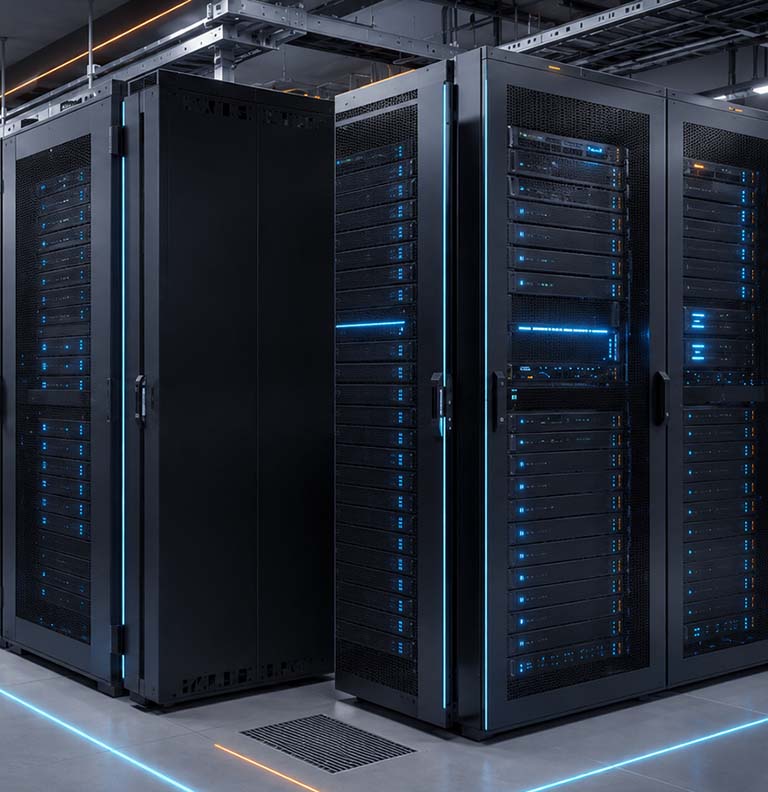

AI Data Centers
Quality Control of Artificial Intelligence Components and Infrastructure
AI data centers—often referred to internationally as AI Data Centers—are the backbone of modern AI applications. They provide the infrastructure for AI software, cloud services, and data-intensive applications. As computing power increases, so do the demands on data transmission, power supply, and cooling. Specialized AI chips, servers, and racks must work together reliably—around the clock, with high performance and minimal risk of failure.
This creates a new dimension of quality for the manufacturing of components for AI data centers. Cooling structures, cables, connectors, packaging, and substrates must be manufactured with precision, processed stably, and tested reliably. Even the smallest defects can impair heat dissipation, signal transmission, or component reliability.
Precitec supports manufacturers in key areas of component manufacturing for AI data centers—from quality assurance in liquid cooling to process monitoring for cables and connectors, and monitoring and inspection of high-precision laser micromachining.
Focus on Three Manufacturing Areas
Liquid cooling
Early detection of leakage risks in cooling structures—through process monitoring during laser welding and optical inspection of critical welds.
Cables and Connectors
Reliably evaluating laser-welded electrical connections—with a focus on process stability, pull-out force, and reproducible quality.
Packaging and Substrates
Monitoring and inspecting high-precision laser micromachining—for PCB, HDI, and ABF substrates, as well as through-glass vias.
Compute, connect, cool – Quality Determines Performance
High-performance AI data centers must provide computing power, transmit enormous amounts of data, and safely dissipate the heat generated.
Compute refers to specialized AI chips, processors, packaging, and substrates.
Connect describes electrical and optical connections between chips, servers, and racks.
Cool encompasses cooling structures, conduits, and liquid cooling systems.
The higher the power density, the tighter the permissible tolerances become. Laser welding processes, electrical contacts, and laser micromachining must be monitored consistently. This ensures that the quality of components for AI data centers is not only verified at the end of the process but is also guaranteed during manufacturing.
Liquid Cooling: When Even the Smallest Leaks Become a Risk
In AI data centers, a large portion of the electrical power consumed is converted into heat. Modern liquid cooling systems therefore play a central role—and place high demands on the manufacturing quality of their components.
The greatest risk is leakage. Leaks in pipes, cooling channels, cold plates, or welded joints can damage sensitive electronics or reduce cooling performance. Laser-welded joints made of stainless steel, copper, or material combinations such as stainless steel and copper are particularly challenging.
Inline process monitoring helps detect critical deviations even during the laser welding process. These include, for example, blowouts, which can indicate potential weak points or future leakage risks. AI-supported analyses can further classify defects and provide indications of possible defect types.
For downstream quality control, laser welds can be inspected visually. This allows for the detection of pores, irregularities, and fine surface deviations—even in complex geometries and structures in the micrometer range.
Cables and Connectors: Reliable Connections for Maximum Data Throughput
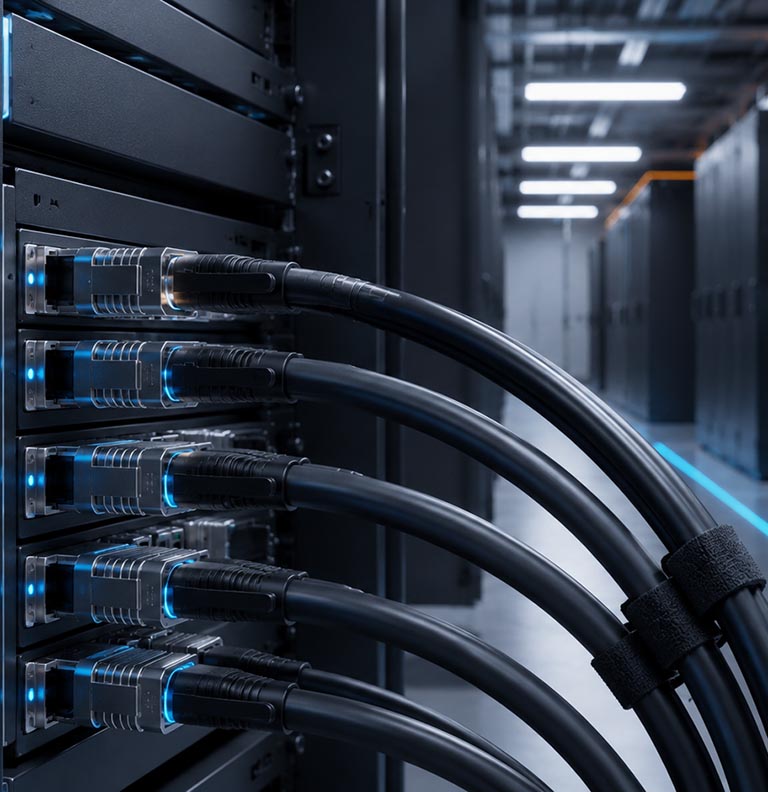
Enormous amounts of data are transmitted between chips, servers, and racks. Cables, connectors, and electrical contacts must therefore be mechanically robust, electrically reliable, and manufactured to ensure reproducible quality.
An important quality characteristic is the pull-out force. If it is too low, cables or connectors can be damaged during assembly, operation, or maintenance and lose their functionality. The contact areas are often made of copper or copper alloys and are welded using green lasers, among other methods.
Intelligent process monitoring makes it possible to evaluate the quality of laser-welded cables and connectors directly during production. The pull-out force can be predicted inline and in real time. Even very short weld spots in the millisecond range can be reliably detected and evaluated.
This enables manufacturers to detect process deviations early on, reduce scrap, and document the quality of electrical components for AI data centers in a traceable manner.
Laser Microprocessing and Measurement Technology for Packaging and Substrates
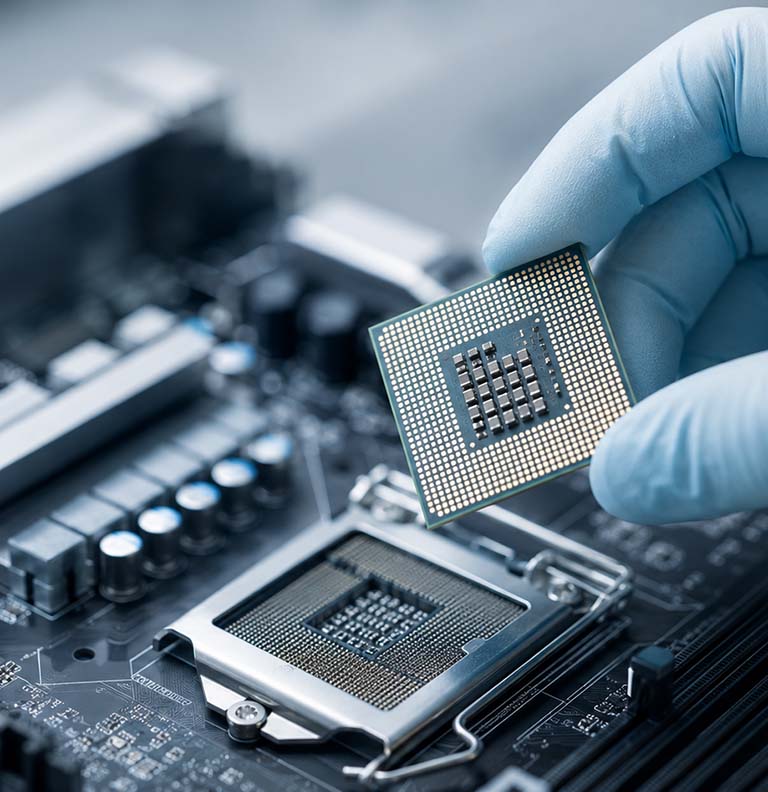
The more powerful AI chips become, the more demanding their operating environment becomes. In semiconductor manufacturing, packaging, wafers, substrates, and ultra-fine interconnect structures must be precisely processed and inspected to ensure reliable signal transmission and high packing densities.
With the rapid development of artificial intelligence, the demands on measurement technology are also increasing. Structures are becoming finer, processes faster, and quality tolerances tighter. Manufacturers therefore need measuring principles that keep pace with this development: fast, non-contact, highly precise, and reliably integrable into industrial manufacturing processes.
Precitec supports these requirements with optical measurement and inspection technologies for quality assurance in semiconductor manufacturing. Fine structures, surfaces, spacing, flatness, and layer thicknesses can be precisely measured, evaluated, and documented—either directly during the process or during downstream inspection.
High-precision laser micromachining is used for PCB, HDI, and ABF substrates, wafer-level processes, and through-glass vias. Modern packaging technologies such as chip-on-wafer-on-substrate or chip-on-panel-on-substrate also place high demands on structural quality, process stability, and reproducibility.
Make quality visible before failures occur
Components for AI data centers must function reliably over the long term. That is why quality must be evident during the manufacturing process—not just through final inspection, scrap, or subsequent failures.
Precitec solutions help manufacturers monitor critical processes inline, detect deviations early, and document quality data in a reproducible manner. This results in stable manufacturing processes for components that are crucial for the performance, cooling, and data transmission of modern AI data centers.
Solutions Tailored for AI Data Centers
Depending on the manufacturing task, various Precitec solutions are used—ranging from inline process monitoring and AI-based defect classification to optical weld inspection and high-precision measurement of fine structures.
Laser Welding Monitor LWM AI – Inline process monitoring with AI-based defect classification, quality prediction, and traceability.
SeamControl – optical inspection of laser weld seams to detect pores, irregularities, and visible seam deviations.
Chromatic Line Sensor CLS – High-precision measurement of the smallest objects, e.g., flatness and defect analysis in AI chip production and micro-machining, as well as µ-bumps in advanced packaging for AI chips.
Flying Spot Scanner – high-precision flatness and thickness inspection for quality assurance in semiconductor production and micro-machining.