

CoaxPrinter - Laser optics for laser deposition welding with wire
Direction-independent laser metal deposition for additive manufacturing, repair and coating
The CoaxPrinter is a processing optic for direction-independent laser deposition welding with wire and is suitable for a wide range of applications in additive manufacturing and wear protection. From filigree structures to complex, large-volume 3D shapes, the laser optics enable continuous and direction-independent material deposition.
Based on the ring-shaped beam shaping and the central wire feed, the filler material is melted homogeneously from all directions and bonded to the component surface with the lowest possible heat input. This allows pore-free layers with high process stability to be produced completely independently of the direction of movement.
Compared to laser deposition welding with powder, the wire-based process offers almost 100% material utilization, as the filler material is completely introduced and processed. This makes the CoaxPrinter particularly attractive for applications such as repair welding, wear protection and the additive construction of 2.5D and 3D structures, where high-quality and expensive materials such as titanium or Inconel are used.
For applications in laser cladding with metal powder, the YC52 coating head complements the Precitec portfolio in the field of additive manufacturing.
Find out more about laser metal deposition with wire in the following video:
What advantages does the CoaxPrinter offer for laser deposition welding?

Direction-independent material application
The CoaxPrinter enables direction-independent laser cladding, as the wire is fed coaxially to the laser beam. In combination with the ring-shaped beam shaping, the filler material is melted evenly in all directions of movement. This allows continuous material application even with complex web movements and supports uniform, pore-free layers with high process stability.

High material utilization with wire-based laser deposition welding
In laser metal deposition with wire, the filler material is completely inserted and processed, resulting in a material utilization of almost 100%. In contrast to powder-based processes, there are no losses due to overspray or unintroduced material. There is also no contamination of the system or the system operator. This supports economical coating and repair processes and makes the CoaxPrinter particularly attractive for applications with high-quality materials or larger order volumes.

Stable and reproducible coating processes
The precise coordination of the laser beam and material feed enables a stable melt pool and thus a reproducible process across the entire processing range. This is particularly advantageous for additive manufacturing processes, repair welding and functional coatings with high quality requirements.
Simple integration and economical operation
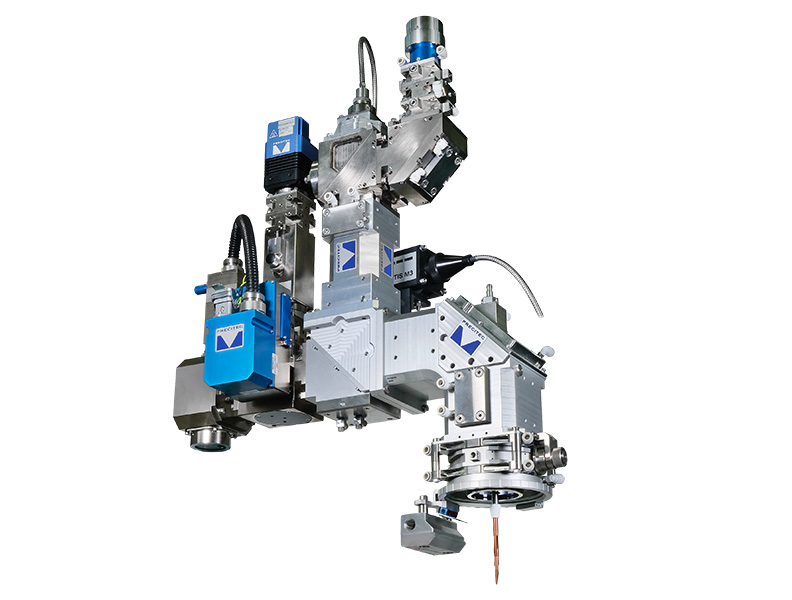
The CoaxPrinter can be put into operation with different laser types in a short time. The optics and the way the wire is fed allow a large process window that permits tolerances in working distance and laser power and supports robust process control.
The processing of different wire materials and wire thicknesses, including cored wires, offers a high degree of flexibility in the application. Integrated process monitoring supports the documentation of the layers applied and contributes to reproducibility and process reliability.
The coaxial wire feed achieves almost 100% material utilization. In combination with high wire speeds of up to 5 m/min, this enables high application rates and economical operation. The targeted heat input also reduces component distortion and reduces the need for downstream processing steps.
What applications are possible with the CoaxPrinter for laser deposition welding with wire?
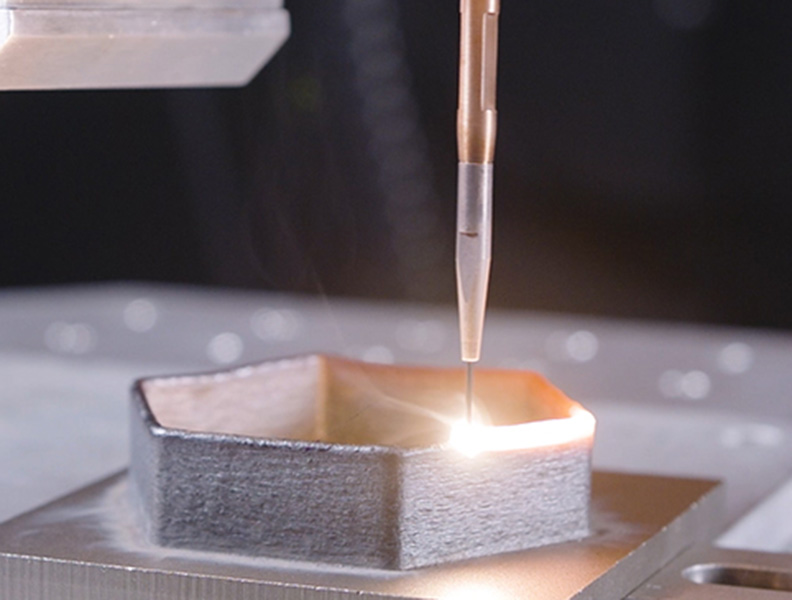
The CoaxPrinter is suitable for a wide range of industrial applications, including:
- Repair welding of high-quality components
for the efficient repair of worn or damaged components - Reconditioning of wear and functional components
with requirements for precise material application and reproducible coating quality - Functional and protective coatings
to improve wear, corrosion or temperature properties - Additive construction of 2.5D and 3D structures
for robust or geometrically demanding components in industrial 3D printing - Rapid prototyping and small series production
for the rapid production of complex prototypes and near-series components - Applications in toolmaking, automotive and aircraft construction
for repair, coating and additive manufacturing processes
Technical data
- max. laser power: 6 kW (cw, 900 - 1080 nm)
- Collimation focal lengths: 55 mm (NA ≤0.22), 100 mm (NA ≤0.13)
- Welding wire diameter: 0.8 - 1.6 mm
We need your consent to load the form!
We use Marketing Cloud Account Engagement (Pardot) Forms to embed content that may collect data about your activity. Please review the details and click in the Pardot box to accept the service and see the content. If the form is not displayed correctly, please click once more on Download the data sheet now.
Do you still have any questions or would you like an offer? Then contact us!


How does laser metal deposition with wire work?
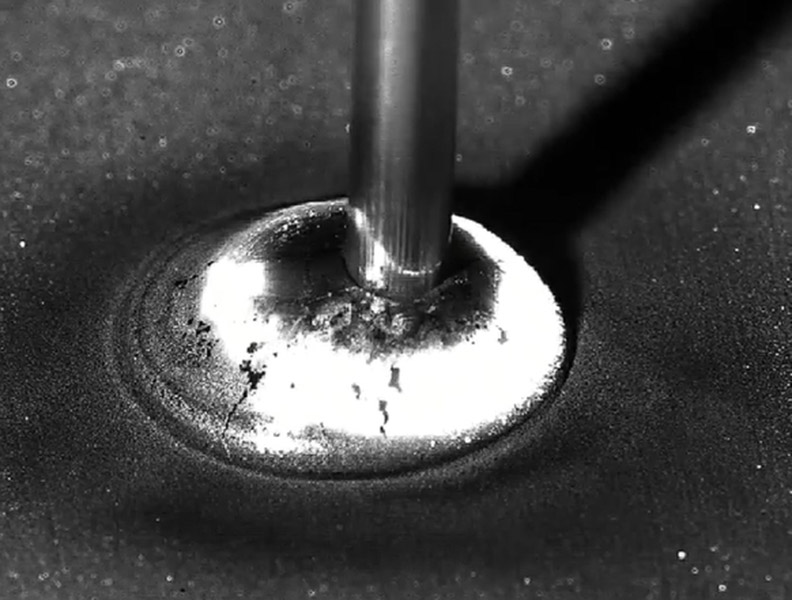
Laser cladding with wire is an additive manufacturing process in which a metallic wire is continuously fed into the focus of a laser beam as a filler material and melted there. The molten material is applied to a component in layers and forms a metallurgically bonded structure or coating.
In wire-based laser cladding, the wire is fed coaxially to the laser beam. In combination with suitable beam shaping, the wire is melted evenly and introduced into the local molten pool on the component surface in a controlled manner. The precise coordination of laser power, wire feed and focus position results in uniform layers with high adhesive strength and reproducible geometry.
The process is suitable for the additive construction of 2.5D and 3D structures as well as for repair and coating processes, especially for larger application volumes or high-quality materials. The optical design of the processing head plays a central role here, as it has a significant influence on energy input, material application and process stability.
Further information on the process and typical applications can be found on our page on laser metal deposition with wire.