Laser cladding - coating, repair and additive manufacturing
What is laser metal deposition?
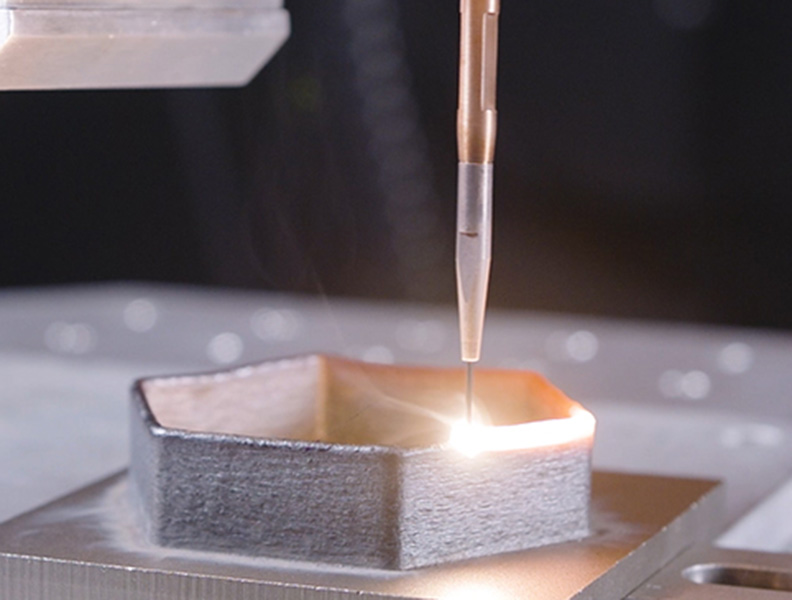
Laser cladding is a specialized process within laser welding technology and at the same time an additive manufacturing process in which metallic filler material is selectively introduced into a molten pool generated by a laser. Internationally, the process is also known as laser cladding, laser metal deposition (LMD) or directed energy deposition (DED).
During the process, either metal powder or wire is fed into the laser melt pool. The deposited material bonds metallurgically with the base material and forms a dense, resilient layer or structure. This allows components to be coated, repaired or built up additively.
Laser metal deposition is used in numerous industries today, including tool and mold making, mechanical engineering, the energy industry and aerospace.
Precise laser beam guidance, uniform material feed and robust process optics are crucial for stable and reproducible processes. Precitec develops high-precision processing heads for laser cladding with powder and wire that are specially designed for industrial applications.
How does laser cladding work?
In laser cladding, the focused laser beam creates a localized weld pool on the surface of the component. At the same time, filler material - either as powder or wire - is introduced into this molten pool.
The process takes place in several steps:
- The laser beam melts the surface of the component locally.
- Additional material is continuously fed in.
- The material melts into the base material.
- A metallurgically bonded layer is created during solidification.
High-quality coatings or additive structures with a defined geometry can be produced through precisely controlled melting and solidification. Modern laser processing heads enable stable process control even with complex component geometries.
High-tech can also be pure aesthetics - the fascination of laser cladding in slow motion
For which applications is laser metal deposition suitable?
Laser cladding is mainly used in applications where components are exposed to high mechanical, thermal or corrosive loads. The most important fields of application include
Wear protection and coating
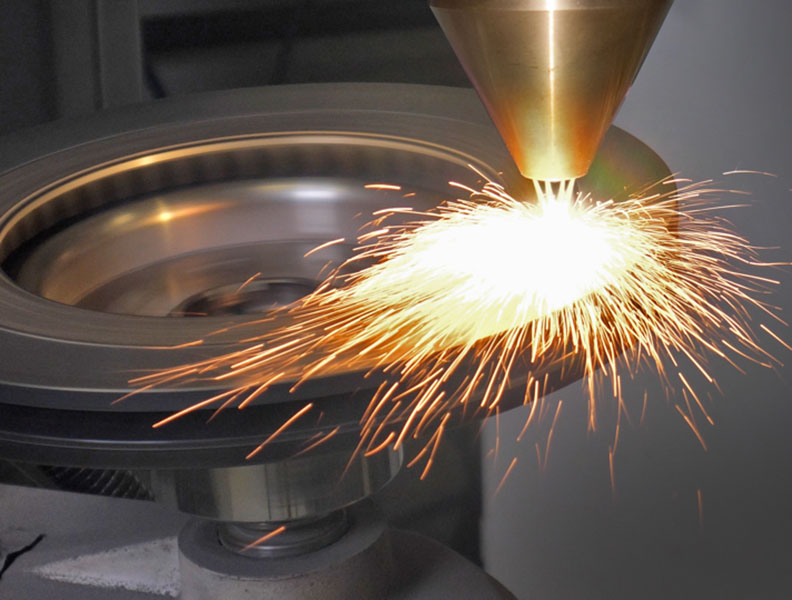
Component surfaces can be specifically improved by applying special alloys. For example, wear-resistant, corrosion-resistant or temperature-resistant layers can be created. Laser cladding is often used to apply wear-resistant coatings to highly stressed components.
Typical applications include
- Valves and pump components
- Turbine blades
- Tools and molds
- Shafts
- Components in mechanical engineering
The precise energy input of the laser enables high-quality coatings with low dilution of the base material.
Repair of high-quality components
Laser metal deposition is often used to recondition worn or damaged components. Damaged areas are specifically rebuilt and then mechanically reworked.
Typical repair applications include
- Turbine components
- Tools and molds
- Components in mechanical engineering
Targeted material application can extend component service life and reduce costs for replacement parts.
Additive manufacturing of large structures
In addition to coating and repair, laser cladding can also be used for additive manufacturing processes. This involves building up metallic structures layer by layer. The process offers advantages over powder bed-based additive manufacturing processes, particularly for large components or high build rates.
Wire-based laser deposition welding plays an important role here, as it is particularly material-efficient. You can find more information on this on our page on 3D printing with lasers.
Laser deposition welding with powder
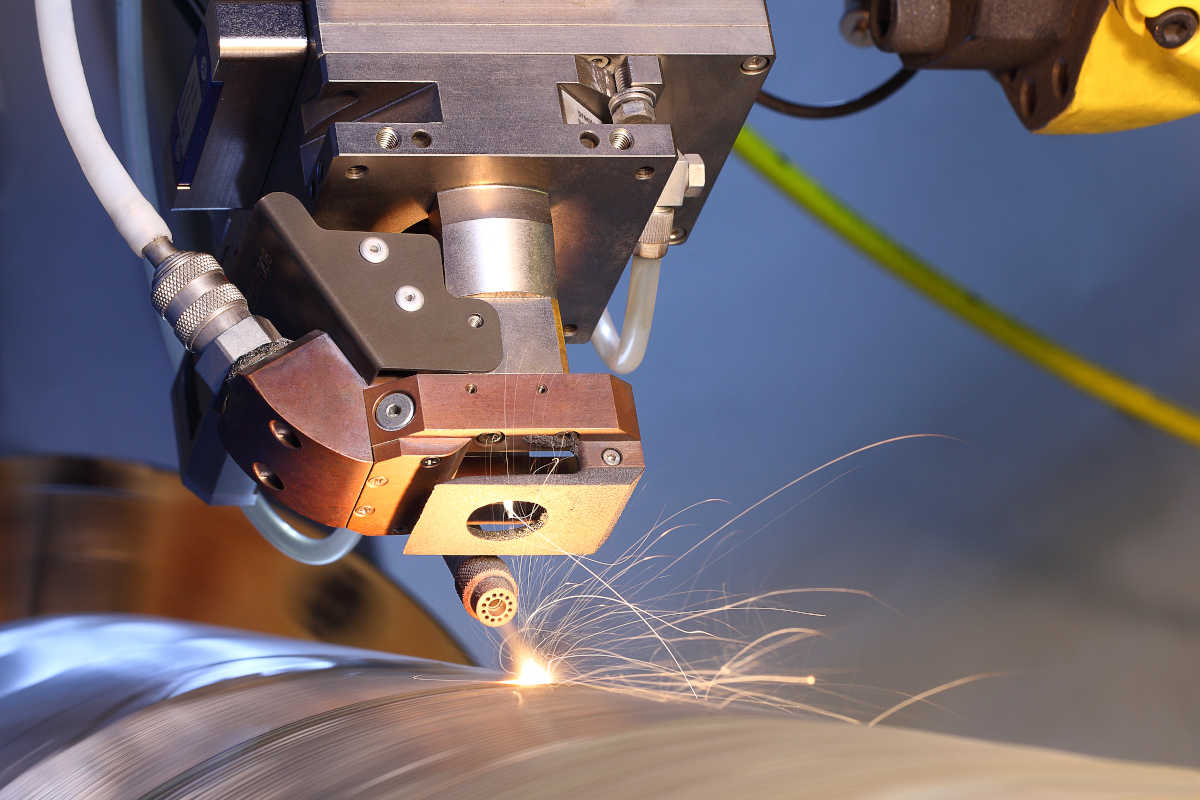
In powder-based laser cladding, metal powder is introduced into the laser weld pool via a nozzle. This process is particularly suitable for precise coatings and repair processes.
A stable powder feed and precise laser optics are crucial for uniform coating quality.
With the VarioCladder YC52, Precitec offers a processing head that has been specially developed for laser cladding with metal powder. The modular nozzle concept allows flexible adaptation to different applications and track widths.
Laser deposition welding with wire
In wire-based laser cladding, a metal wire is continuously inserted into the laser weld pool. This process enables high build-up rates and very high material efficiency, as almost all of the filler material is used.
Wire-based processes are frequently used in the additive manufacturing of metal components.
Precitec develops processing heads with coaxial wire feed for this purpose, which enable stable material feed regardless of the direction of movement.
Further information on this technology can be found on our page on 3D printing with lasers.