
Laser Welding Monitor LWM: Real-Time Process Monitoring
Detect Welding Defects Early and Document Every Weld
The Laser Welding Monitor LWM monitors industrial laser welding processes inline and in real time. It captures quality-relevant process signals and compares the characteristic process fingerprint of each weld with defined reference data. Deviations are detected immediately, while the process data for every individual weld is fully documented.
The sensors’ high dynamic range enables applications ranging from micro-welding delicate electronic and medical technology components to high-power welding in the automotive industry, battery and energy storage production, aerospace, and mechanical engineering. Whether short cycle times, leak-tight joints, or safety-critical components are involved, the LWM provides the transparency required to reliably evaluate weld quality and ensure stable series production.
The Laser Welding Monitor is designed for industrial 24/7 operation and can be flexibly integrated into welding optics, scanner optics, laser sources, and existing production lines. This also makes the system suitable for highly automated applications in consumer electronics and the home appliance industry.
Process Monitoring for Laser Welding Battery Cells
The video shows how the Laser Welding Monitor captures quality-relevant process signals during battery cell production and enables continuous evaluation of every individual weld.
Your advantages with the Laser Welding Monitor LWM

Detect Process Deviations Early
The LWM compares the process fingerprint of each weld with previously defined reference data in real time. Significant deviations become immediately visible. This allows defective welds to be identified at an early stage and specifically removed from the subsequent production process.
Inline monitoring helps reduce scrap, rework, and unplanned downtime while increasing production output in series manufacturing.

Fully Document Every Weld
All relevant process data is stored and documented for each individual component. The Laser Welding Monitor therefore provides end-to-end traceability of the monitored welding processes.
Combined with unique component identification and integration into higher-level production systems, this creates a reliable data basis for quality assurance, process analysis, and production optimization.
Stable Evaluation – Even with Changing Material Batches
New material batches or changes in component properties can cause systematic shifts in the process signals. The LWM’s intelligent software package detects these signal shifts and can automatically adjust the parameter settings—without requiring the entire process to be retrained.
This ensures that the evaluation remains stable and traceable even when production conditions change.
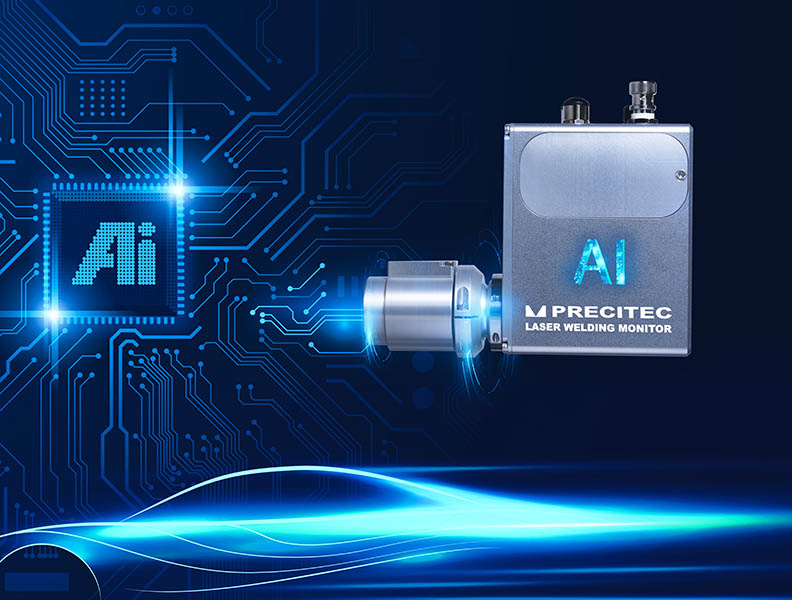
LWM AI: AI-Based Extension of Process Monitoring
The conventional Laser Welding Monitor LWM detects deviations based on the process fingerprint and documents the quality of every individual weld. If specific defect types or physical properties of the weld are also required, the LWM can be extended with LWM AI.
The AI-based extension classifies application-specific process defects and—depending on the process and training data—predicts physical properties such as strength or electrical conductivity.
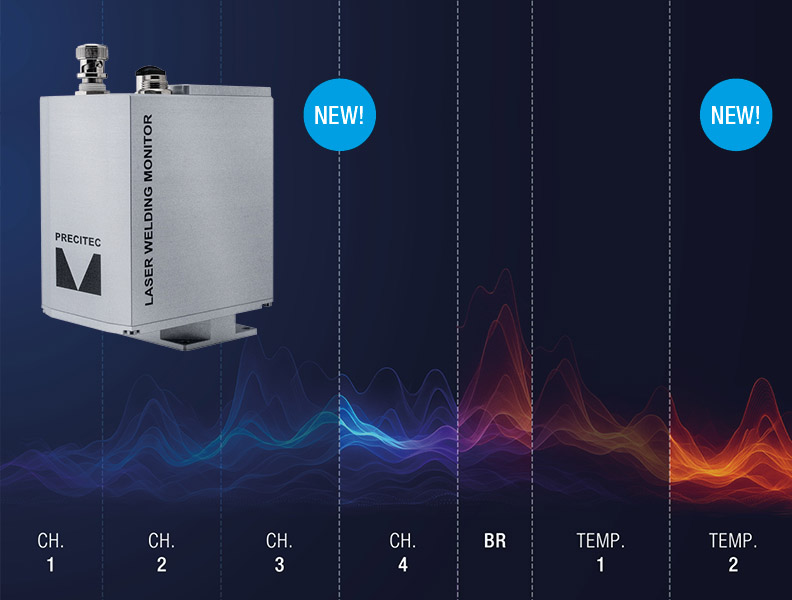
LWM 8.50: Highly Sensitive Process Monitoring
More Process Signals for Demanding Welding Applications
The Laser Welding Monitor LWM 8.50 expands the Precitec sensor family with additional optical measurement channels. This enables even minor changes in process signals to be detected with high sensitivity. This is particularly beneficial when welding demanding materials such as copper, aluminum, or stainless steel.
Additional temperature channels enable thermal processes to be monitored into the near-infrared range. With a sampling rate of up to 50 kHz, the sensor is also suitable for highly dynamic micro-welding processes with short pulse durations and low laser power.
Integration without complex X/Y alignment reduces installation effort and makes the system easier to use in both new and existing production systems.
Detection of typical welding defects
- Change in laser power and focus position: Fluctuations in laser power or an incorrect focus position (focus shift) can lead to uneven weld seams or insufficiently welded joints. Quality monitoring detects these changes and helps to continuously optimize the process parameters.
- Gap between top and bottom sheet: If the gap between the components to be welded is too large, the connection cross-section may be insufficient or, in extreme cases, there may be no connection at all (“false friend”). In contrast to a visual inspection or a camera inspection, this defect can be reliably detected with the Laser Welding Monitor quality assurance system.
- Contaminated components: Surface contaminants such as oil, dust or rust can impair the welding quality and lead to unsafe welded joints. Quality monitoring can be used to determine whether the components are clean enough to enable an error-free welding process.
- Spatter: Contamination can cause spatter, which can lead to problems in some applications. The high sampling rate of the Laser Welding Monitor quality monitoring system can detect this spatter, which often occurs quickly and spontaneously.
- Visible pores: Material ejections (spatter) can lead to visible pores or continuous holes in the laser weld seam.
The detection of these typical defects by the Laser Welding Monitor LWM ensures that consistently high quality is achieved in production. Real-time detection also enables targeted reworking in the production plant. This effectively reduces production costs and increases production efficiency.
Which applications is the Laser Welding Monitor suitable for?

Battery Production, E-Mobility, and Energy Storage
In the production of battery cells, modules, and packs, the LWM monitors demanding welding processes such as foil-to-tab, cap-to-can, and terminal contact welding. Changes in energy input, component position, or surface condition become visible during the process.
Component-specific documentation supports the traceability of safety-critical joints and helps remove suspect welds from the subsequent production process at an early stage. This helps reduce scrap, rework, and unnecessary quality inspections.
Learn more about laser welding of batteries for e-mobility
Automotive Manufacturing and Industrial Series Production
In automotive manufacturing, the Laser Welding Monitor supports quality monitoring when welding body, structural, powertrain, and safety components. The system is suitable for applications involving steel, aluminum, copper, and application-specific material combinations.
Continuous process monitoring also provides greater transparency in mechanical and plant engineering, aerospace, and the series production of home appliances. Deviations are detected at an early stage before suspect components reach downstream production steps.
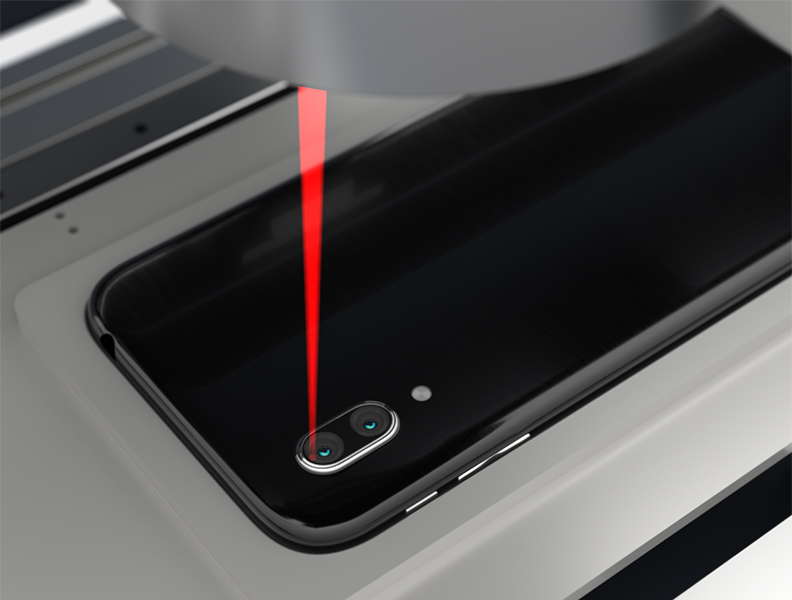
Consumer Electronics and Medical Technology
Small components, thin materials, and short cycle times place particularly high demands on process monitoring. The LWM also captures highly dynamic micro-welding processes, such as those used for electronic components, smartphones, sensors, and medical technology components.
Inline evaluation makes unusual process patterns immediately visible and documents the captured data for every weld. The LWM therefore supports high production yields and stable series production—even with short cycle times and demanding quality requirements.
Technical data
- Solid-state laser application: for IR / blue / green laser and CW or pulsed mode
- Installation options: possible in laser welding optics, scanner optics or directly in the laser source
- Deep penetration welding, heat conduction welding or high-speed welding
- Flexible interfaces: TCP/IP, fieldbus, digital I/O
- OPC-UA protocol for communication with MES systems (compatible with TRUMPF QDS, among others)
We need your consent to load the form!
We use Marketing Cloud Account Engagement (Pardot) Forms to embed content that may collect data about your activity. Please review the details and click in the Pardot box to accept the service and see the content. If the form is not displayed correctly, please click once more on Download the data sheet now.
Do you have any further question or would you like to get an offer? Then contact us!