
Remote laser welding and scanner welding for industrial series production
Highly dynamic laser welding with scanner optics for automotive and battery production
Remote laser welding, also known as scanner welding, enables highly dynamic and economical welding processes for industrial series production. With scanner optics and sensor systems from Precitec, these processes can be implemented stably and reproducibly in automated production lines. Large focal lengths create a generous processing field in which the laser beam is precisely directed onto the workpiece via fast-moving deflection mirrors. This process offers significant productivity advantages, especially in applications with many short seams or complex component geometries - for example in the automotive sector or in battery production.
In remote welding, the laser beam is guided via fast-moving deflection mirrors (galvo scanners) and precisely positioned on the workpiece. As neither the processing head nor the component has to be moved between individual welding points, non-productive times are significantly reduced. The result is short cycle times, high process stability and excellent reproducibility of the weld seams.
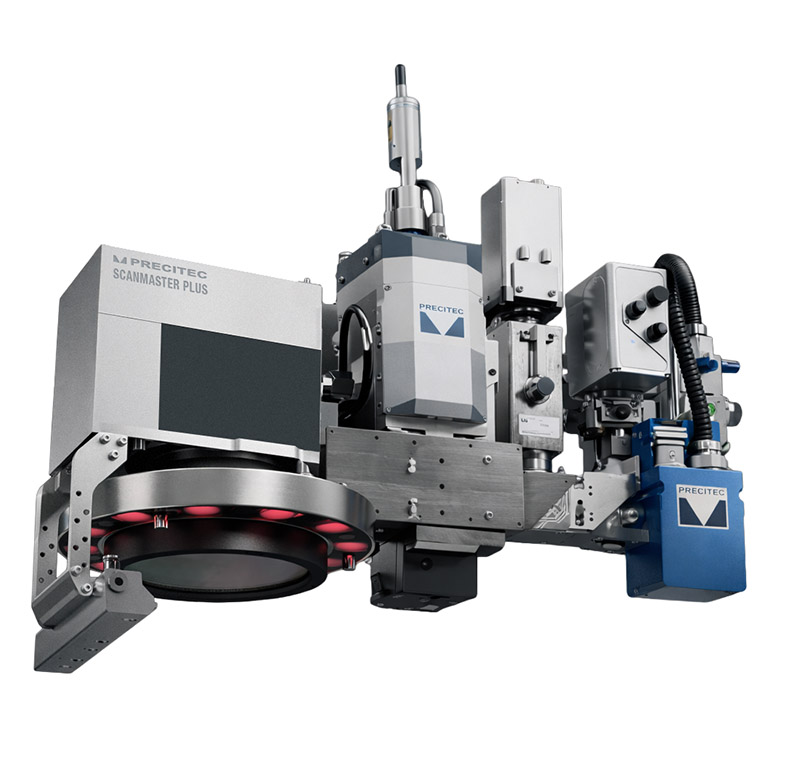
For industrial series production, Precitec offers the ScanMaster Plus, a powerful scanner optic for remote laser welding. The system combines precise distance measurement, component position detection and integrated process monitoring. This enables stable processing even with component tolerances or dynamic production conditions.
The ScanMaster Plus supports reliable and efficient production, particularly in the highly automated production of battery components for electromobility. The combination of highly dynamic beam guidance and intelligent sensor technology ensures reproducible weld seams as well as high electrical conductivity and tightness - decisive quality features for modern battery modules and housings.
ScanMaster Plus – Scanner Optics for Highly Productive Remote Laser Welding
Highly dynamic scanner welding with integrated sensors and continuous process monitoring
- Fast and flexible remote processing for short cycle times
- Precise component detection and autofocus for stable processes
- Combined evaluation of camera, OCT, and LWM data in a single system for maximum process reliability
For which applications is remote laser welding suitable?
Remote laser welding is primarily used in highly automated production environments where short cycle times, high process stability and reproducible weld seams are crucial. Thanks to the highly dynamic beam guidance and the large processing field, scanner welding is particularly suitable for components with many individual welding points or short seams.
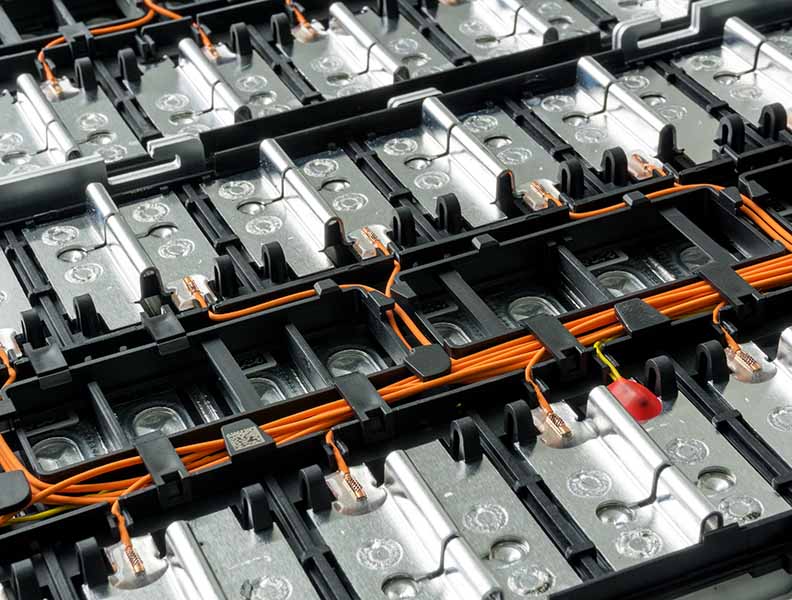
Typical applications include:
- Battery housings for electric vehicles
- Battery modules and the welding of battery cells and electrical connecting elements
- Hairpin welded joints in electric motors
- Body-in-white structures in automotive production
- Thin-walled structural components in lightweight construction and e-mobility applications
In these applications, remote laser welding enables cost-effective production with short cycle times, high process stability, and reproducible weld seams. Thanks to the high dynamics of the scanner and flexible beam guidance, even complex welding geometries and many individual joints can be realized in a short time.