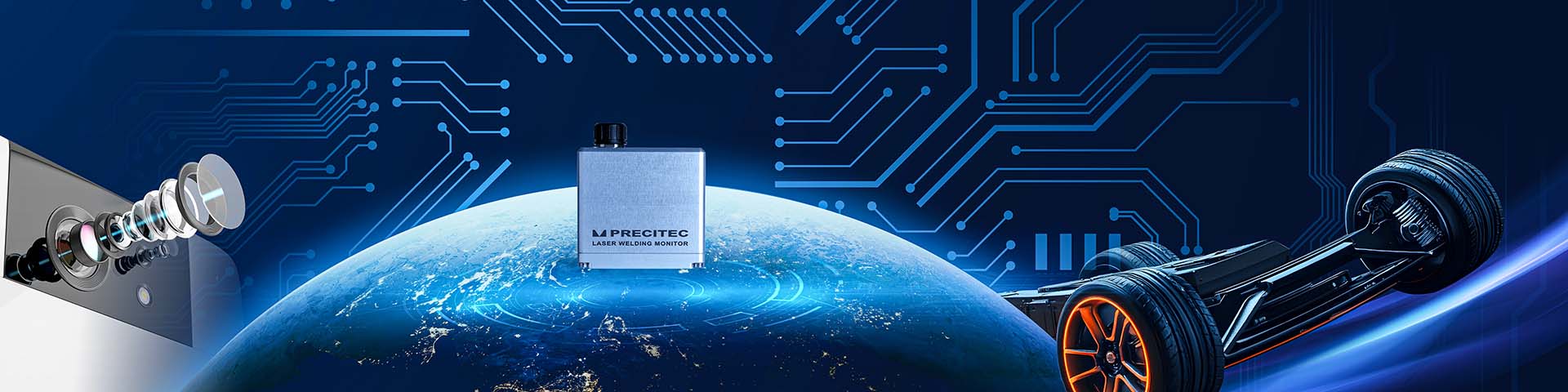
Quality control of your laser welding processes in real time
The Laser Welding Monitor LWM is used for online process monitoring in industrial production in 24/7 operation.
In series production, it records and documents quality- and productivity-related process data for laser weld seams for all relevant laser welding processes, such as heat conduction welding or keyhole laser welding. Depending on the configuration level, this data forms the basis for a classic or AI-supported process evaluation.
The high dynamic range of the sensors enables the monitoring of high-performance welding applications through to micro welding applications.
Quality fluctuations caused by component tolerances, contamination or wear are reliably detected and monitored. The system is simple and intuitive to operate and can be flexibly integrated into almost any customer application, facility and infrastructure.
The combination of comprehensive quality control, flexibility and precision makes the Laser Welding Monitor LWM an indispensable tool for maximum quality and efficiency in modern laser welding production.
Learn more about process monitoring for laser welding of battery cells:
Your advantages with the Laser Welding Monitor LWM

Increasing output
The Laser Welding Monitor LWM increases productivity through precise real-time monitoring of the laser welding process. It detects deviations in welding parameters and seam quality by comparing the process fingerprint with the current process data. This identifies faulty welds in real time, minimizes rework and rejects and reduces downtimes.

100% traceability and transparency
All process data is consistently stored and documented for each component. In combination with online backups, the system enables 100% traceability and transparency of your laser welding processes.

Intelligent adaptation of fault detection
New material batches can lead to systematic, abrupt shifts in the process signals. These shifts can be detected by the intelligent software package and the parameterization can be adapted automatically - without the need for a new teach-in.
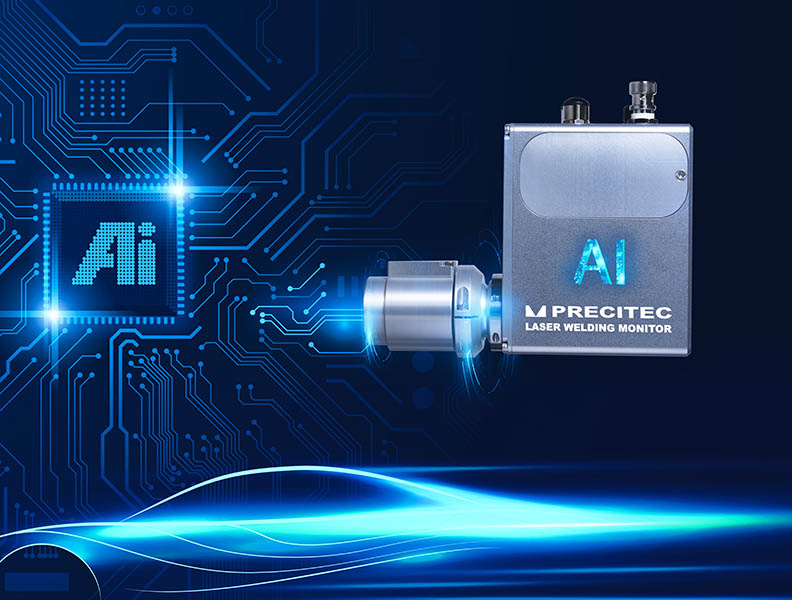
Optimized quality monitoring with artificial intelligence
Battery contacting with AI
The demands placed on production processes are constantly evolving and require innovative solutions. Artificial intelligence opens up completely new possibilities for increasing efficiency and quality. With the LWM AI, Precitec is setting new standards and enabling the clear classification of process errors and the precise prediction of physical properties of laser weld seams. The result: an objective and quantifiable analysis of welding quality - perfect for meeting even the highest quality requirements.
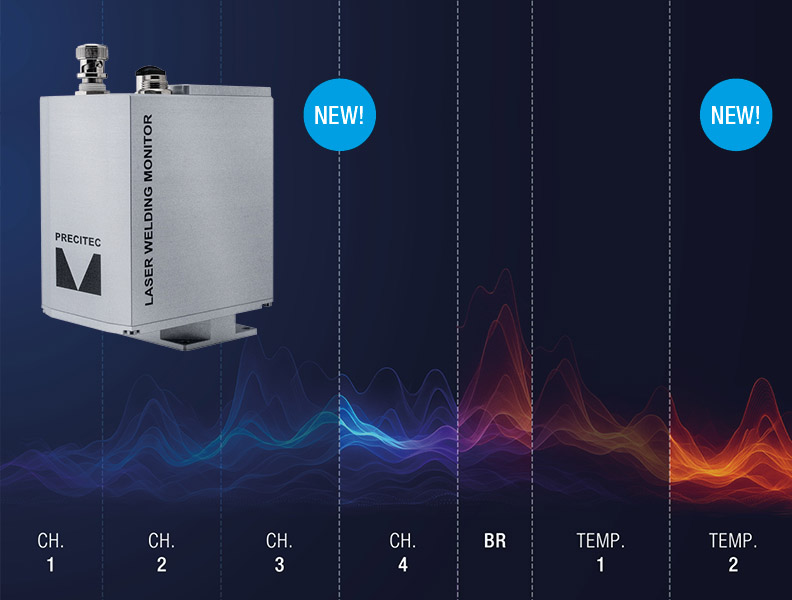
New sensor for particularly sensitive process monitoring
Reliable quality monitoring for stable welding processes
The new Laser Welding Monitor 8.50 is the most advanced addition to the Precitec sensor family for process monitoring in laser welding: thanks to additional optical channels, it detects welding errors even more sensitively in real time, thereby increasing process stability. The sensor really comes into its own when welding different materials such as copper, aluminum or stainless steel. Two additional temperature channels enable seamless monitoring of thermal processes - even in the NIR range. The high sampling rate of 50 kHz allows it to be used in micro welding applications with low laser power and pulse durations. The simple integration without X/Y alignment also saves time and reduces installation costs.
Detection of typical welding defects
- Change in laser power and focus position: Fluctuations in laser power or an incorrect focus position (focus shift) can lead to uneven weld seams or insufficiently welded joints. Quality monitoring detects these changes and helps to continuously optimize the process parameters.
- Gap between top and bottom sheet: If the gap between the components to be welded is too large, the connection cross-section may be insufficient or, in extreme cases, there may be no connection at all (“false friend”). In contrast to a visual inspection or a camera inspection, this defect can be reliably detected with the Laser Welding Monitor quality assurance system.
- Contaminated components: Surface contaminants such as oil, dust or rust can impair the welding quality and lead to unsafe welded joints. Quality monitoring can be used to determine whether the components are clean enough to enable an error-free welding process.
- Spatter: Contamination can cause spatter, which can lead to problems in some applications. The high sampling rate of the Laser Welding Monitor quality monitoring system can detect this spatter, which often occurs quickly and spontaneously.
- Visible pores: Material ejections (spatter) can lead to visible pores or continuous holes in the laser weld seam.
The detection of these typical defects by the Laser Welding Monitor LWM ensures that consistently high quality is achieved in production. Real-time detection also enables targeted reworking in the production plant. This effectively reduces production costs and increases production efficiency.
In which applications is the Laser Welding Monitor particularly effective?
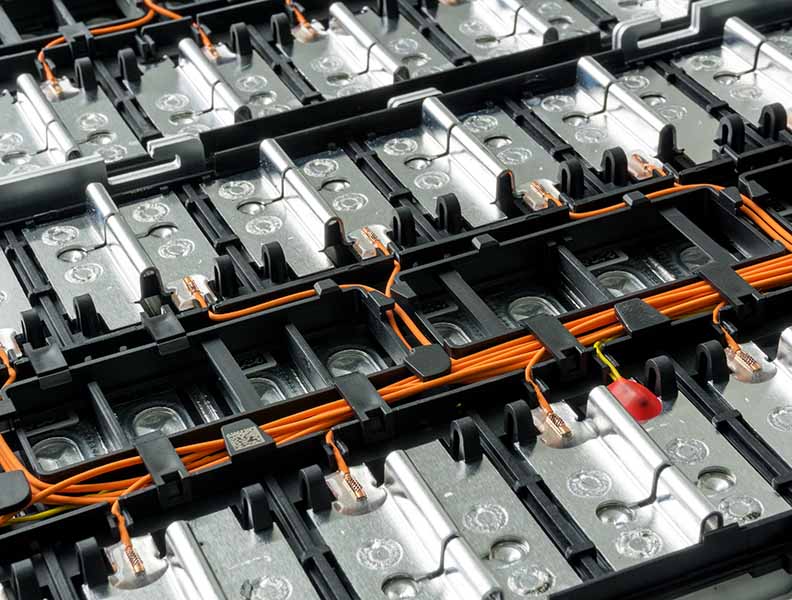
Battery cell production & e-mobility
The Laser Welding Monitor LWM offers high-precision, real-time quality monitoring for demanding laser welding processes in battery cell and battery module production. Inline monitoring ensures stable and reproducible process control, especially for laser welding of foil-to-tab, cap-to-can, and connection contacts.
Thanks to the integrated LWM AI's machine learning algorithms, not only can process deviations be reliably detected and classified, but the physical properties of the weld seam, such as strength and electrical conductivity, can also be precisely predicted. Each individual welding process is analyzed, classified, and documented in real time—a crucial prerequisite for quality assurance of safety-critical components in e-mobility. This allows for a sustainable reduction in scrap, rework, and expensive overkills.
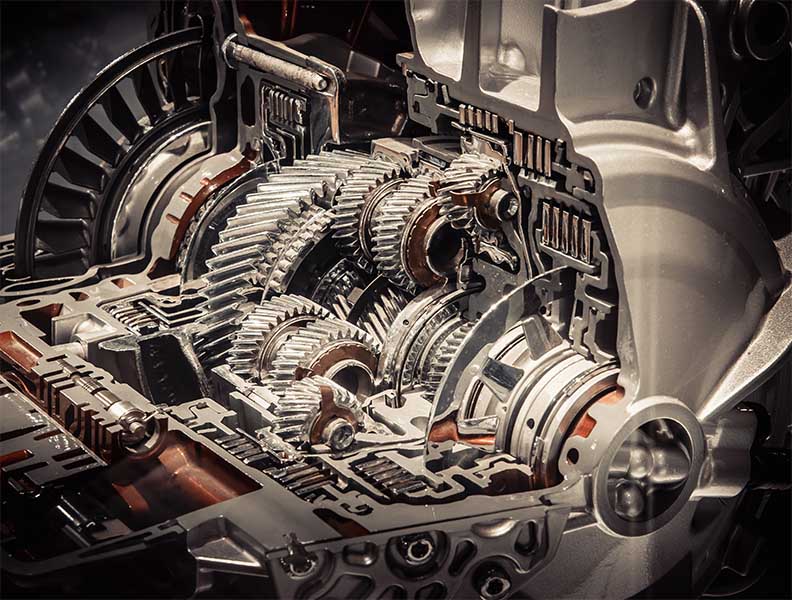
Traditional automobile construction
In traditional automotive manufacturing, quality monitoring with the Laser Welding Monitor LWM supports the efficient production of car bodies, structural components, and safety-related components made of steel, aluminum, or mixed materials. Real-time process monitoring during laser welding ensures that every weld seam meets the high requirements for dimensional accuracy, strength, and reproducibility.
Continuous inline monitoring detects process deviations at an early stage, significantly reducing scrap rates and enabling stable series processes. The Laser Welding Monitor LWM thus contributes significantly to robust, economical, and quality-assured automotive production.
LWM AI reliably detects and classifies process deviations and predicts weld seam properties such as strength and conductivity in real time. This improves the quality assurance of safety-relevant components and reduces scrap and rework.
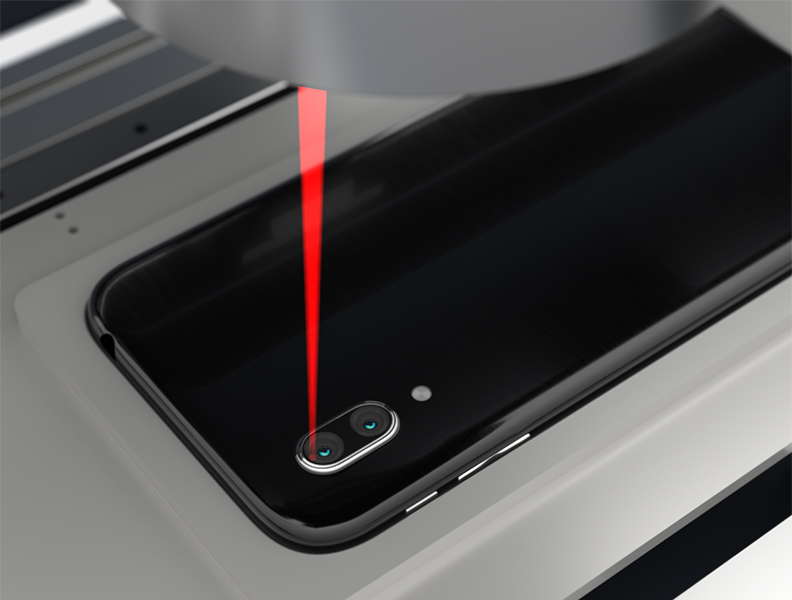
Consumer Electronics
In the production of consumer electronics such as smartphones, tablets, and laptops, the Laser Welding Monitor LWM enables precise inline quality monitoring of highly dynamic and delicate laser welding processes. Especially with small components, thin materials, and short cycle times, the high sensitivity of the system ensures maximum process reliability.
Real-time monitoring of the weld seams ensures consistently high product quality and creates complete transparency throughout the entire production process. Faulty welded joints are reliably detected before they reach downstream process steps – a decisive factor for high yields, short cycle times, and stable series production in the electronics industry.
With LWM AI, every laser welding process of consumer electronics components is intelligently evaluated: deviations are automatically detected, error types classified, and relevant seam parameters predicted. This results in objective, quantifiable quality assurance.
Technical data
- Solid-state laser application: for IR / blue / green laser and CW or pulsed mode
- Installation options: possible in laser welding optics, scanner optics or directly in the laser source
- Deep penetration welding, heat conduction welding or high-speed welding
- Flexible interfaces: TCP/IP, fieldbus, digital I/O
- OPC-UA protocol for communication with MES systems (compatible with TRUMPF QDS, among others)
We need your consent to load the form!
We use Marketing Cloud Account Engagement (Pardot) Forms to embed content that may collect data about your activity. Please review the details and click in the Pardot box to accept the service and see the content. If the form is not displayed correctly, please click once more on Download the data sheet now.
Do you still have any questions or would you like an offer? Then contact us!